Teaching as Hope
Rooted in family, faith and a belief in radical kindness, one UW student is preparing to shape the next generation—at home and around the world.
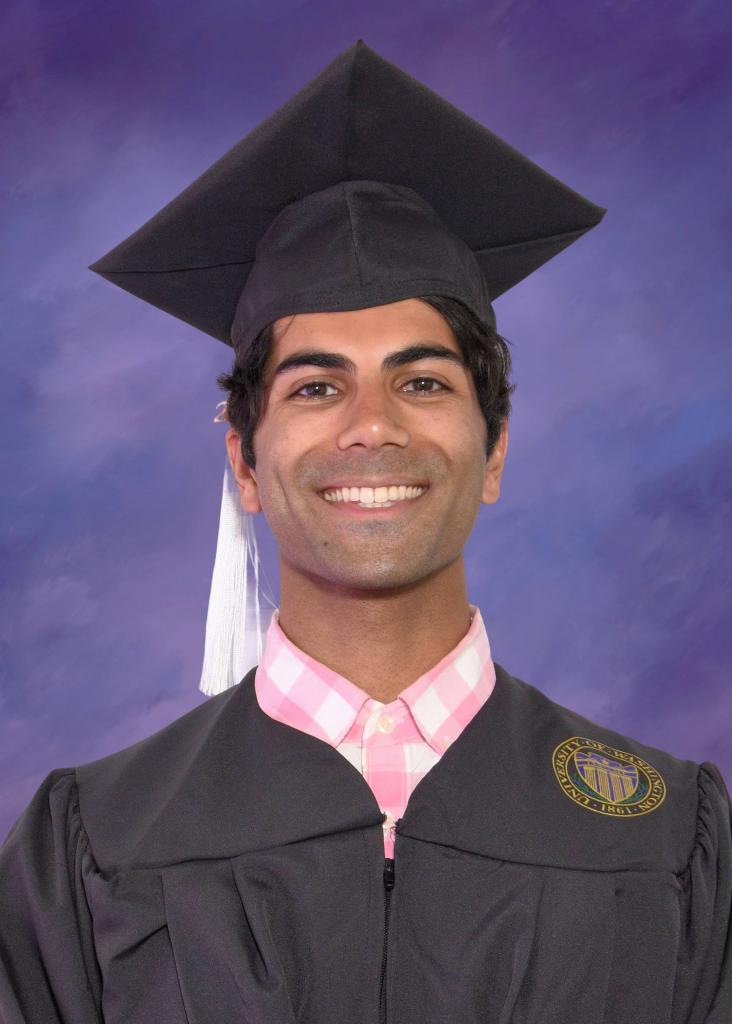
For Zain Suleman, teaching is a calling.
Born and raised in Kirkland and Redmond, Suleman grew up surrounded by opportunity and expectations. Like many young Americans, he absorbed the cultural script early: chase success, secure financial stability, measure worth by status. But somewhere along the way, that script stopped making sense.
"I felt lost," he said of his late teens. "I started asking myself what actually matters."
The answer came from community, and from a deeper understanding of who he is. Suleman is a first-generation American whose family traces its roots to Tanzania, South Africa, and Pakistan. He identifies as an Ismaili Muslim, part of a small global community that emphasizes pluralism, education and service. In young adulthood, he began volunteering within his faith community with children, many of them immigrants and refugees from Afghanistan. During a spirited game of Duck Duck Goose, something clicked.
"I remember seeing their joy," he said. "Their innocence. I thought, I just want to be around this. And I want to protect it."
That sense of purpose sharpened as he reflected on what society chooses to reward. At age 20, Suleman had built a sizable online following — tens of thousands of followers, with his videos collectively reaching over a million viewers. But instead of feeling fulfilled, he felt unsettled.
"I noticed people treated me differently because of a number on a screen," he said. "That bothered me."
He deleted his social media accounts and recalibrated his priorities, guided by a lesson from his father: "The most important thing in this life is how we treat other people."
That philosophy now guides his work in the classroom. Suleman is currently pursuing a Master's in Teaching in the UW College of Education's Elementary Teacher Education Program (ELTEP), an intensive one-year pathway that places candidates in classrooms from the very first quarter. Each candidate is paired with a university coach and a mentor teacher, while faculty members — many veteran K–12 educators — guide students through pedagogy, equity-centered practice and the emotional complexity of teaching.
"They don't just teach us how to teach math," he said. "They teach us how to teach people."
For Suleman, preparation is ultimately about mindset. He describes teaching as "an act of hope and persistence"; hope, because children are still forming their understanding of the world; persistence, because the work pushes back against inequity.
"If kids are sponges, we can teach them to be kind," he said. "We can model acceptance. We can show them that people who look or speak differently still deserve respect."
"If kids are sponges, we can teach them to be kind. We can model acceptance. We can show them that people who look or speak differently still deserve respect."
As a student teacher, he has worked with children from a wide range of backgrounds...West African, Afghan, Latino, white American and more. The diversity has reinforced what he already believed: that effective teaching requires cultural humility and genuine connection.
"I don't want to be a teacher who leaves parts of himself at the door," he said. "I want to bring my full self to my students, and create space for them to do the same."
After graduation, Suleman hopes to teach in the communities that shaped him — Grass Lawn, South Rose Hill, Redmond and Kirkland. He is passionate about supporting students from Middle Eastern, Muslim and South Asian backgrounds who may not see themselves reflected in their teachers, while remaining clear that his commitment extends to everyone. "If you need a helping hand, I want to be there," he said.
His long-term vision stretches further still. Suleman dreams of building schools in rural communities across East Africa, South Asia and the Middle East, and is interested in the responsible use of AI to expand learning in remote regions. "If technology is coming anyway, let's use it to reach kids who don't have anything."
When his future students leave his classroom, he hopes they carry two enduring lessons: that they are capable and worthy, and that kindness is essential. "I want them to feel empowered. And I want them to treat people with compassion, no matter what."
Teaching, he believes, is one of the oldest and most necessary professions in human history—always about passing forward knowledge, values and care. For Suleman, that continuity is both local and global.
"It's not just a job," he said. "It's a life path."
